
Oct
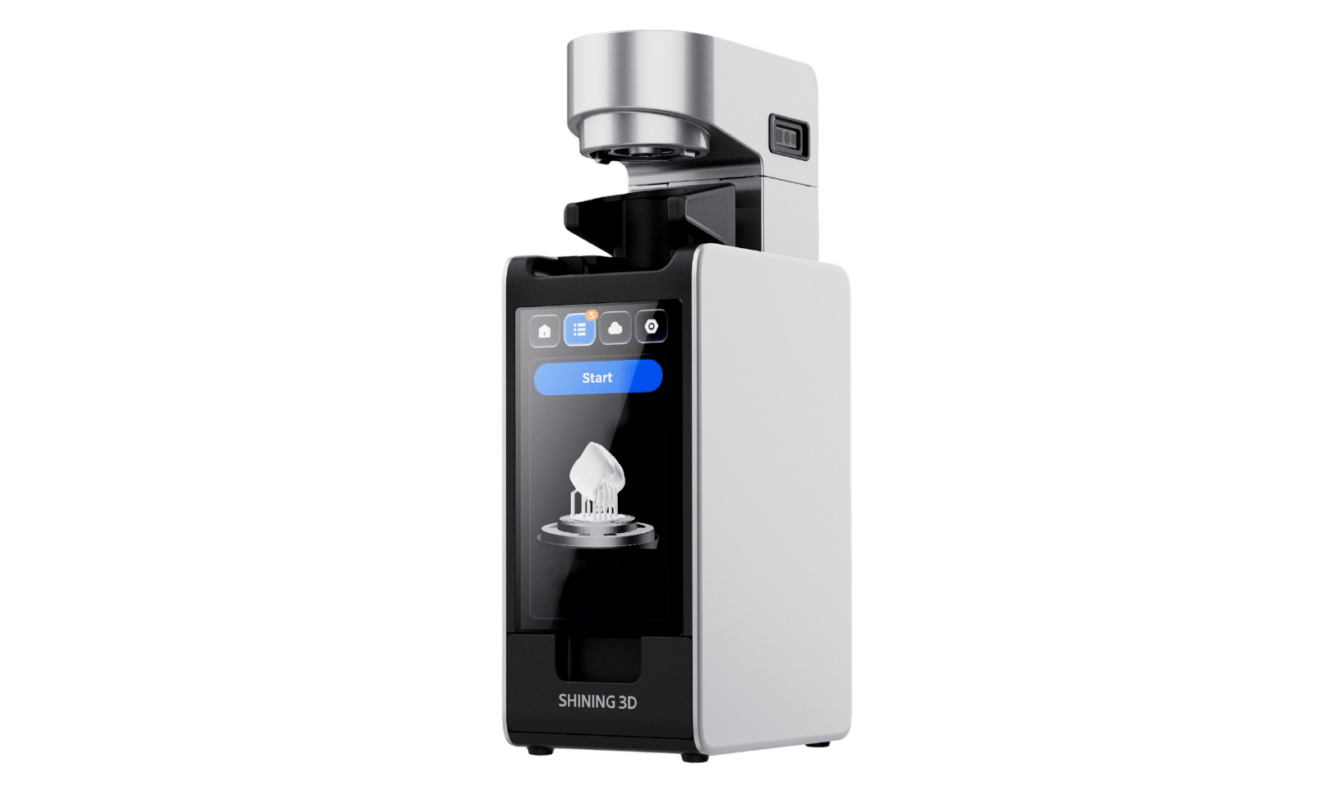
The SHINING 3D Ceramix-Nano is a chairside dental 3D printer built for one job: permanent single-visit restorations. It weighs about 2 kg, fits on a countertop next to the treatment chair and prints and cures a crown in one enclosure. According to SHINING 3D, the full process from scan to cementation can take about 30 minutes.
For practices that have wanted same-day crowns without the cost, space and maintenance of a chairside milling unit, this is a new option. Below we explain how the SHINING 3D Ceramix-Nano works, what it can make, and which practices it fits best.
What Is the SHINING 3D Ceramix-Nano?
The Ceramix-Nano is a capsule-based printer, not a general-purpose resin printer. Instead of pouring resin into an open vat, you load a sealed, pre-measured capsule. A QR code on the capsule tells the printer which material and shade it is using, and the printer sets itself up, mixes the material and starts the job.
This matters chairside. In a busy practice, the printer may be run by an assistant between patients. The capsule format removes resin handling, tray cleaning and manual settings, which are the steps where most print errors start.
The Ceramix-Nano is designed for:
- General dentists who want to offer same-day crowns without a milling unit
- Small and mid-size practices with little space for equipment
- Practices already using intraoral scanners that send crown cases to a lab today
- Multi-location groups that want the same simple workflow in every office
It is not meant to replace a lab printer for models, dentures or surgical guides. For those, a full-size lab printer is a better fit.
Key Features and Specifications
APS: Printing Thick, Ceramic-Filled Resins
Highly filled restorative resins are thick, which makes them hard to print reliably. SHINING 3D solved this with its patented Adaptive Pneumatic Stereolithography (APS). It separates each layer with air pressure and controls peeling force in real time, so dense material prints cleanly.
LumiCera Capsules
The printer is optimized for LumiCera, a ceramic-filled resin that SHINING 3D says contains more than 50% ceramic filler. It is offered in VITA shades BL, A1, A2, B1 and C2. One capsule can produce up to three restorations. The printer also supports Saremco CROWNTEC for practices that prefer that material.
Integrated Printing and Curing
Printing and curing happen in the same unit, so no separate curing device is needed for the chairside workflow. A calibration-free auto-leveling system runs before each print.
Technical Specifications
| Specification | SHINING 3D Ceramix-Nano |
|---|---|
| Technology | APS (Adaptive Pneumatic Stereolithography), DLP |
| Print wavelength | 400–410 nm |
| XY resolution | 50 µm |
| Curing wavelength | 360–385 nm |
| Single crown print time | about 8–11 min, plus integrated curing |
| Total chairside fabrication | about 15 min |
| Size | 87 × 131 × 276 mm (3.4 × 5.2 × 10.9 in) |
| Weight | about 2 kg (4.6 lb) |
| Materials | LumiCera capsules; Saremco CROWNTEC |
| Software | SHINING FLOW cloud platform with AI crown design |
The Chairside Workflow: Scan to Seat in One Visit
- Scan. Capture the preparation with an intraoral scanner. Scan quality decides fit.
- Design. Upload the scan to SHINING FLOW. Its AI crown design proposes a restoration in about two minutes, which the dentist reviews and adjusts.
- Load the capsule. Insert the LumiCera capsule in the shade you need. The printer reads the QR code and prepares itself.
- Print and cure. The design file is sent automatically. A single crown prints in about 8–11 minutes and is cured inside the same unit.
- Finish and cement. Polish or characterize the restoration and cement it while the patient is still in the chair.
What You Can Make
According to SHINING 3D, the Ceramix-Nano produces permanent crowns, veneers, inlays, onlays and bridges of up to three units, including Maryland bridges. Always follow the material’s indications for each case.
Why It Matters for the Practice
- One appointment instead of two. No temporary crown, no second visit, no lost temporaries.
- Fewer lab fees for single-unit restorations.
- Small footprint. No dedicated lab room is required.
- Simple operation. Pre-measured capsules lower the training needed and keep results consistent between staff members.
Ceramix-Nano vs a Chairside Mill or a Lab Printer
| SHINING 3D Ceramix-Nano | Chairside milling unit | Open-vat lab printer | |
|---|---|---|---|
| Main job | Single-visit permanent restorations | Single-visit restorations from blocks | Models, guides, dentures, temporaries |
| Material handling | Sealed capsules | Blocks, burs, coolant | Open resin vat, wash, separate cure |
| Space needed | Countertop, about 2 kg | Larger unit, often a separate room | Printer plus wash and cure stations |
| Best for | Practices new to same-day dentistry | High-volume restorative practices | Labs and practices with broad applications |
If your practice also needs models, guides or dentures, the Ceramix-Nano works well alongside a full-size lab printer.
FAQ: SHINING 3D Ceramix-Nano
How fast can the Ceramix-Nano make a crown?
SHINING 3D states that a single crown prints in about 8-11 minutes, followed by about 3 minutes of integrated curing. The full scan-to-cementation visit can take around 30 minutes.
Are the restorations permanent?
Yes. The Ceramix-Nano is designed for permanent restorations using ceramic-filled LumiCera resin. Check the material’s instructions for indications and limits for each case.
What shades are available?
LumiCera capsules come in VITA shades BL, A1, A2, B1 and C2.
How many restorations does one capsule make?
According to SHINING 3D, one capsule is enough for up to three restorations.
Do I need a separate curing unit or wash station?
No. Printing and curing take place inside the Ceramix-Nano, so no extra post-processing equipment is required for the chairside workflow.
Can I use other materials?
The printer is optimized for LumiCera and also supports Saremco CROWNTEC.
Is it a good fit for a dental lab?
The Ceramix-Nano is built mainly for chairside use. Labs that need models, dentures, guides and high-volume production are better served by a full-size lab printer.
🛒 Ready to try the SHINING 3D Ceramix-Nano? Go to the Ceramix-Nano product page at Articon to request a quote, or call us at (800) 316-8085.