
Trainings
3D Printed Night Guards vs Milled: Which Holds Up Better?
Oct
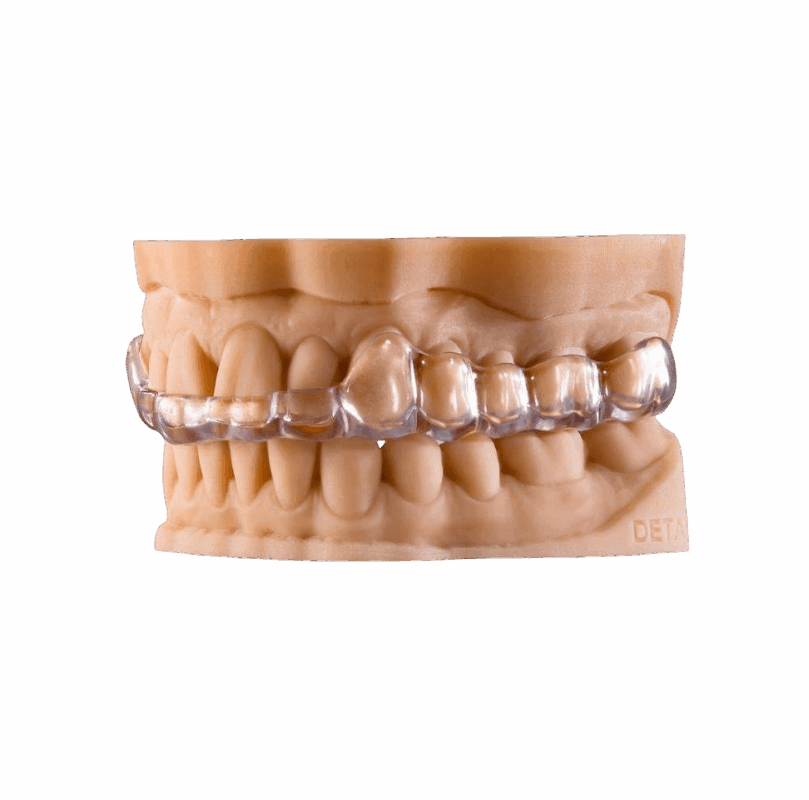
3D printed night guards have become one of the fastest-growing appliances in digital labs, but milled PMMA splints are still the benchmark many dentists trust. Both start from the same scan and the same CAD design. The difference is in the material, the production method and how the appliance performs after months of grinding.
So which one holds up better? The honest answer: it depends on the patient, the material and how well the workflow is run. This guide compares printed and milled night guards on fit, durability, comfort, cost and turnaround, so you can choose the right method case by case.
How Each Method Works
3D Printed Night Guards
The night guard is designed in CAD and printed layer by layer from a light-cured resin. Night guard resins come in hard and flexible or thermo-flexible versions; some soften slightly with mouth temperature for easier seating. After printing, the appliance is washed, post-cured and polished. Several guards can be printed on one platform at once.
Milled Night Guards
A milled night guard is cut from a pre-polymerized PMMA disc, such as Dental Direkt Bio Splint P HI. Because the disc is polymerized industrially under controlled conditions, the material is dense and uniform. The mill removes material with fine burs, and the result needs only light polishing.
Head-to-Head Comparison: Printed vs Milled Night Guards
Milled PMMA usually wins on long-term wear and fracture resistance; 3D printed night guards win on cost, speed and comfort options. The table sums up the trade-offs.
| Factor | 3D printed night guards | Milled night guards (PMMA) |
|---|---|---|
| Fit | Very good with validated settings and correct orientation | Very good; limited only by bur size in fine areas |
| Durability and wear | Good; varies widely between resins | Generally higher, thanks to dense pre-polymerized material |
| Comfort | Flexible and thermo-flexible options available | Rigid; a hard splint only |
| Clarity and esthetics | Can yellow or haze if under-cured or poorly stored | Stays clear and polishes to a high gloss |
| Cost per unit | Lower, especially in batches | Higher material cost per disc unit |
| Turnaround | Fast; many units in one overnight print | One unit per milling cycle, more machine time |
| Equipment | 3D printer + wash + curing unit | Milling machine + burs |
Note that results depend on the specific material. Always compare products using their technical data sheets, not general claims. Our guide on reading a resin technical data sheet explains flexural strength, modulus and the other values that matter for splints.
When to Print and When to Mill
Choose 3D printed night guards when:
- The patient is a mild to moderate grinder or clencher
- Comfort matters most and a flexible or thermo-flexible material is preferred
- You produce many guards and want low cost per unit
- Fast turnaround or same-day delivery is important
- A replacement or a backup guard is needed from an existing file
Choose milled night guards when:
- The patient is a heavy bruxer who has worn through or broken previous guards
- The dentist prescribes a hard, highly polished PMMA splint
- Long-term clarity and color stability are priorities
- The case is a long-term occlusal splint for TMD therapy, as prescribed by the clinician
Many labs offer both and let the case decide. If you already own a mill, see how the imes-icore One, 150i and 350i series compare for splint production.
Tips for Better Night Guards, Printed or Milled
- Design thickness for the material. Flexible resins and hard PMMA need different minimum thicknesses. Follow the manufacturer’s guidance.
- Orient printed guards correctly. Keep supports off the occlusal and intaglio surfaces where possible to protect fit and reduce finishing time.
- Never shortcut post-curing. Under-cured printed guards can be weaker, discolor faster and may not meet biocompatibility claims.
- Use sharp, correct burs for PMMA. Worn burs leave rough surfaces and add polishing time. See our tips for choosing milling burs.
- Save every design file. Replacing a lost or worn guard becomes a reprint or re-mill, not a new case.
FAQ
How long do 3D printed night guards last?
It depends on the resin, the design thickness and how hard the patient grinds. Mild grinders often get long service from a well-made printed guard; heavy bruxers may wear through it faster than a milled PMMA splint.
Are 3D printed night guards comfortable?
Yes. Flexible and thermo-flexible night guard resins are often more comfortable than rigid splints, which can improve patient compliance.
Is a milled night guard stronger than a printed one?
In general, pre-polymerized PMMA discs offer higher density and wear resistance. Some newer printing resins are closing the gap, so compare the technical data sheets of the specific materials.
Can the same design be printed or milled?
Usually yes. The CAD design is the same; you only adjust minimum thickness and export settings for the material and production method.
Which is cheaper to produce?
3D printed night guards are typically cheaper per unit, especially when several are printed in one batch. Milled guards cost more in material and machine time.
Need night guards without new equipment? Articon’s milling service and resin printing service produce both types from your STL files.