
Aug
A resin technical data sheet can look like a wall of numbers, and it is easy to skim past it and just trust the marketing. That is a mistake. Buried in that sheet are the few specifications that decide whether a resin will even print on your machine, whether it is safe for its intended use, and whether it will perform in the mouth. Learning to read a data sheet is one of the most useful skills in a digital lab, and it is simpler than it looks once you know which fields actually matter. Here is a practical guide.
What Is a Resin Technical Data Sheet?
A technical data sheet (TDS) is the manufacturer’s official specification for a resin: its physical, mechanical, optical, and biological properties, plus its intended use and processing instructions. It is different from a safety data sheet (SDS), which covers handling and hazards. The TDS is what you use to decide whether a resin fits your printer, your workflow, and your case. Not every number carries equal weight, so the goal is to know which ones to check first.
The Specs That Actually Matter
1. Curing wavelength. This is the first thing to check, because if it does not match your printer, nothing else matters. Dental resins are usually formulated for 385 nm or 405 nm. A resin whose wavelength does not match your printer’s light source will not cure properly. Confirm this before anything else.
2. Validated printers and compatibility. Many sheets list the printers a resin is validated on, or state that it is an open material requiring user calibration. A validated, profiled combination is plug-and-play; an unlisted printer means you will develop and test settings yourself.
3. Viscosity. Viscosity affects both handling and which printer can run the resin. High-viscosity, highly filled resins (many permanent crown materials) flow and cure best on printers with a heated tank, while low-viscosity resins are easier to pour and clean up. If your printer is not heated, a very viscous resin may not perform.
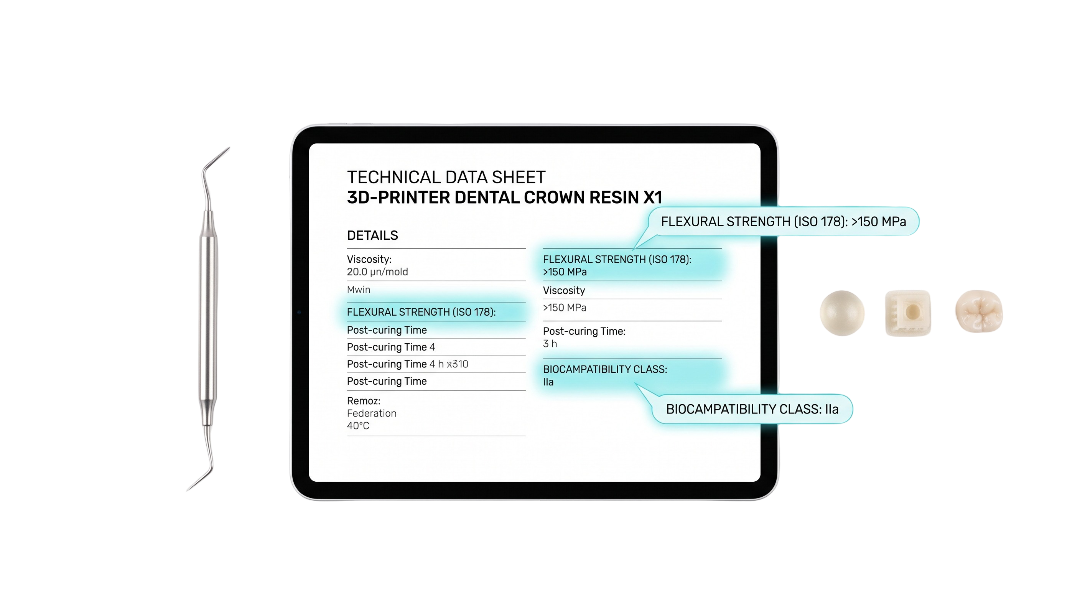
4. Mechanical properties. These describe how the cured part behaves under force, and they are frequently misread. Flexural strength (in MPa) is the resistance to bending before failure. Flexural modulus is stiffness, or how much it resists flexing. Elongation at break indicates toughness versus brittleness. Hardness reflects surface resistance to wear. Match these to the job: a model resin wants stiffness and hardness, a splint may want some flexibility, a permanent crown wants strength and wear resistance.
5. Water sorption and solubility. Often overlooked, these matter enormously for anything worn in the mouth. Low water sorption means the material resists absorbing saliva, which protects dimensional stability, hygiene, and resistance to staining. High values are a warning sign for long-term intraoral use.
6. Biocompatibility and intended duration. For anything contacting tissue, check the biocompatibility certification (ISO 10993 testing, and the regulatory class such as FDA Class I or IIa) and, critically, the permitted contact duration. A surgical guide is rated for short-term contact under 24 hours, while a permanent crown is cleared for long-term use. These are not interchangeable.
7. Indications and intended use. The TDS states what the resin is actually cleared and designed for. A resin optimized for models is not a restorative material, and using a resin outside its stated indications is both a quality and a liability risk. Read this section literally.
8. Post-processing parameters. This is where many good prints are ruined. The sheet specifies the wash approach, the post-cure device, wavelength, time, and sometimes energy, and whether an inert or heated cure is needed. Following the validated cure cycle is what delivers the resin’s stated strength and biocompatibility, so treat these numbers as instructions, not suggestions.
Beyond these, useful secondary fields include accuracy or shrinkage figures, color and shade options, density and yield (which drive your real cost per part), and shelf life and storage conditions.
Specs People Misread
A few honest warnings will save you trouble. Do not confuse flexural strength with fracture resistance; they measure different things, and a high number in one does not guarantee performance in the other. Do not assume a biocompatibility class alone tells you the resin is fine for your case, since the permitted contact duration matters just as much. Do not ignore the post-cure specification because a generic cycle “usually works,” as under and over curing both degrade properties. And do not treat two resins as interchangeable just because their headline strength looks similar; viscosity, wavelength, indications, and post-processing can all differ.
How to Use a Data Sheet to Choose a Resin
Read a TDS in a practical order. First, confirm the wavelength and printer compatibility, because a resin you cannot print is a non-starter. Second, check the indications and biocompatibility to confirm it is cleared for your actual case. Third, match the mechanical and water-sorption properties to the demands of the job. Finally, note the post-processing requirements so you know you can reproduce the validated result. Run through those four steps and you will avoid the most common and expensive resin mistakes.
FAQ
What is the difference between a TDS and an SDS? A technical data sheet (TDS) describes a resin’s performance properties and intended use. A safety data sheet (SDS) covers handling, hazards, and safety. You use the TDS to choose and process a resin, and the SDS to handle it safely.
Which spec should I check first? Curing wavelength and printer compatibility. If the resin does not match your printer’s light source, it will not cure properly, so nothing else matters until that lines up.
What does flexural strength actually tell me? It measures how much bending force the cured resin resists before failing, reported in MPa. It is useful for comparing materials, but it is not the same as fracture resistance, and it should be matched to the demands of the specific restoration or appliance.
Why do post-processing numbers matter so much? Because the resin only reaches its stated strength and biocompatibility when washed and cured to specification. A guessed or generic cure cycle can leave a part weak, brittle, or not fully biocompatible.
How do I compare cost between resins? Look at density and yield, not just bottle price. The real number that matters is cost per finished part, which depends on how many parts a bottle produces for your typical case sizes.
Bottom Line
A resin technical data sheet is not busywork, it is your shortcut to choosing the right material and avoiding failed prints. Focus on the specs that decide the outcome: wavelength and printer fit first, then indications and biocompatibility, then mechanical and water-sorption properties, then the post-processing cycle. Read those four areas every time and you will pick resins that actually fit your printer, your workflow, and your cases.
🛒 Explore validated dental resins for every indication at Articon, and reach out if you want help matching a material’s data sheet to your printer and workflow.